 Musei nazionali di Perugia – Direzione regionale Musei nazionali Umbria
La bottega dei Satna/
La bottega dei Satna
La produzione artigianale
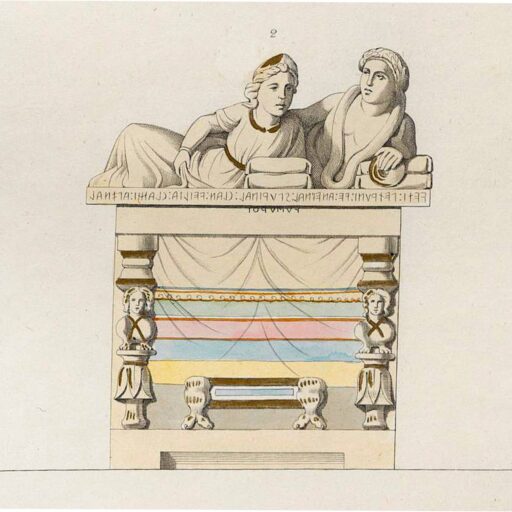
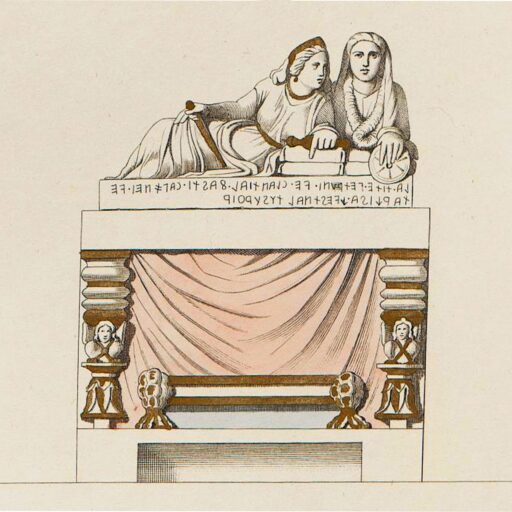
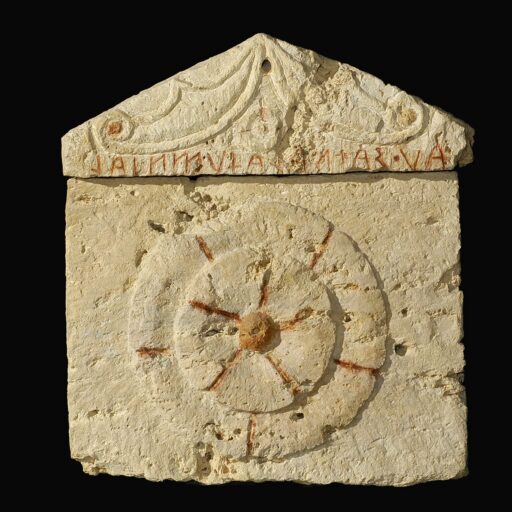
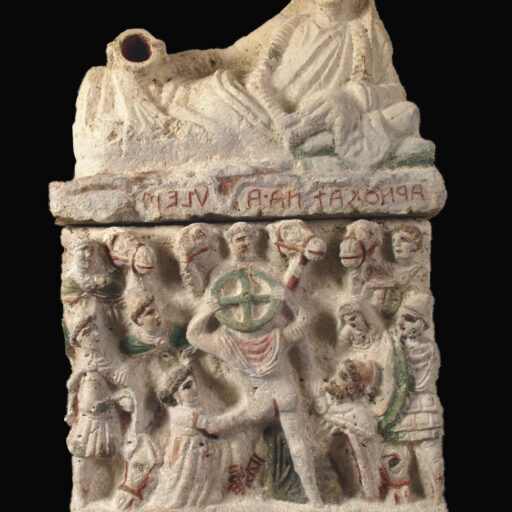
Le urne esposte, che conservano cospicue tracce di policromia, appartengono alle famiglie Tite Petruni e Satna. Quelle dei Satna (II-I sec. a.C.) furono realizzate per Fasti Lachumni, moglie di un Satna, deposta al centro della parete di fondo della tomba con i figli, i nipoti e ulteriori membri della famiglia: le ossa combuste erano raccolte all’interno delle urne in un panno che poggiava su un telo ripiegato. Anna Eugenia Feruglio, che nel 1967 scavò la sepoltura in località Ponticello di Campo, ipotizzò che le urne fossero prodotte in una stessa bottega, che dai committenti denominò la Bottega dei Satna. Perugia, tra fine III e I sec. a.C., produsse un’enorme quantità di urne, prevalentemente in travertino, grazie all’abbondanza di materia prima reperibile nelle cave di Santa Sabina, ubicate in prossimità di Corciano. La cava era verosimilmente organizzata a gradoni e ciascun blocco veniva estratto incidendo la roccia con tagli verticali scavati a piccone, e quindi distaccato tramite cunei inseriti alla base del lato libero. Dalla cava, i blocchi, appena sbozzati per eliminare difetti e regolarizzarne la forma, giungevano alla bottega dello scalpellino, probabilmente a conduzione familiare, dove si affaccendavano artigiani e artisti più o meno dotati, apprendisti, decoratori, scultori, pittori. Qui il blocco veniva scavato internamente per la realizzazione della cavità che avrebbe ospitato le ceneri o le ossa del defunto. Per l’esterno della cassa, cartoni e modelli, presi in prestito dal mondo greco, aiutavano a realizzare le decorazioni, a basso o alto rilievo, con elaborate scene mitologiche o più schematici motivi ornamentali richiesti allo scalpellino dal committente etrusco. Il coperchio era invece conformato a doppio spiovente oppure raffigurava il defunto a banchetto. La materia prima molto resistente, ma anche molto irregolare, era talvolta resa uniforme in superficie mediante un sottile strato di intonaco, su cui erano stesi (in corso le analisi per determinare la tecnica, pittura a secco oppure affresco) i brillanti e variegati colori – oggi in gran parte perduti – delle decorazioni, in alcuni casi impreziosite dall’uso di oro applicato su una preparazione a base di ocra.
Gli Etruschi a colori
Le urne ellenistiche perugine (III-I secolo a.C.) e quelle della Bottega dei Satna, erano in origine vivacemente dipinte. Le analisi multimetodiche, condotte con microscopio elettronico e spettrometro Raman, hanno permesso di riscoprirne la tavolozza cromatica, oggi in gran parte scomparsa.
La base
Prima di applicare il colore, talvolta steso direttamente sul travertino, la superficie poteva essere preparata con uno strato di calce o gesso.
I pigmenti puri
Si tratta di minerali naturali quali l’ematite per i rossi, le ocre per le tonalità giallo-aranciate, la glauconite per i verdi, argilla detta terra verde, il nero dal carbone di legna.
Il blu egizio
Caso particolare è rappresentato dal blu egizio, il più antico pigmento artificiale conosciuto, che gli Etruschi sintetizzavano miscelando sabbia quarzosa, minerali di rame, calce e natron, cuocendoli a circa 800-1000°C.
Le miscele
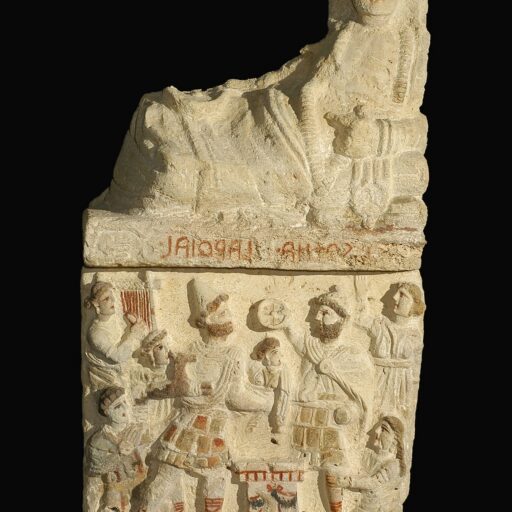
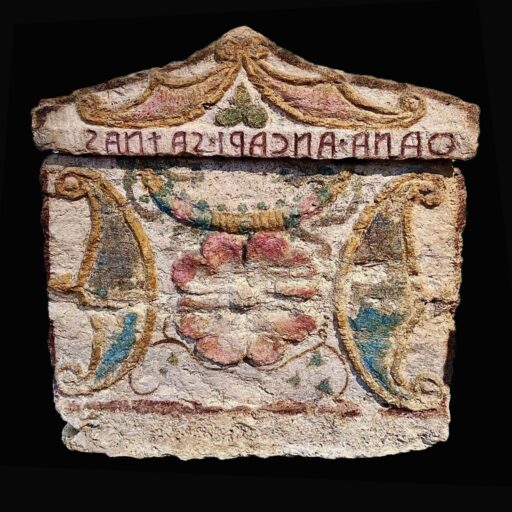
I pigmenti erano spesso mescolati con argille diverse che ne modificavano il cromatismo, rendendolo più tenue se caolinitiche e ricche in alluminio, o volgendolo al verde se illitiche e ricche di ferro. Unendo ad esempio il blu egizio alla glauconite, si ottenevano sfumature tra il blu e il verde, come nei decori dell’urna di Thana Ancari. Per i marroni, come nella barba di Ulisse sull’urna di Vel Satna, si mescolavano nero, ocre e blu egizio.
Immagini:
Necropoli del Palazzone – Tomba dei Tite Petruni (II-I sec. a.C.).
- I coniugi Vel Tite Petruni e Veilia Clanti raffigurati su un’urna in forma di kline (letto).
- I coniugi Larth Tite Petruni (figlio di Vel) e Fasti Capznei raffigurati su un’urna in forma di kline (letto).
Necropoli di Ponticello di Campo -Tomba dei Satna (II-I sec. a.C.).
- Urna di Aule Satna, figlio di una Lachumni. Sulla cassa: un rosone.
- Urna di Vel Satna figlio di Sulla cassa: sacrificio di Ifigenia.
- Urna di Arnth Satna figlio di Aule. Sulla cassa: Pelope e Enomao.
- Urna di Thana Ancari moglie di un Satna. Sulla cassa; rosone tra pelte (scudi semilunati) e tralci di edera.
The workshop of the Satna family
Craftwork
The urns on display, which preserve significant traces of polychromy, belong to the Tite Petruni and Satna families. The Satna urns (2nd-1st centuries BC) were made for Fasti Lachumni, the wife of a member of the Satna family, placed at the centre of the rear wall of the tomb with her children, grandchildren and other relatives: the burnt bones were collected and put inside the urns in a cloth that rested on a piece of folded canvas. Anna Eugenia Feruglio, who excavated the burial in Ponticello di Campo in 1967, suggested that the urns were made by the same workshop which she referred to as the Satna workshop after the name of the family who commissioned them.Between the late 3rd and the 1st centuries BC, Perugia produced a huge number of urns, mainly made from travertine due to the abundance of the raw material which was readily available in the quarries of Santa Sabina, situated close to Corciano. The quarry probably had a stepped structure and each block was extracted by making vertical cuts in the rock with a pickaxe, and then detached using wedges inserted into the base of the free face.The blocks, roughly hewn in order to eliminate defects and to obtain a regular shape, were taken from the quarry to the stonemason’s workshop. It was probably a family-run enterprise, a hive of activity where fairly skilled artisans and artists, apprentices, decorators, sculptors and painters worked alongside each other.Here the block was hollowed out to contain the ashes or bones of the deceased. Cartoons and models, borrowed from the Greek world, helped stonemasons to decorate the exterior, either in low or high relief, with elaborate mythological scenes or more schematic ornamental motifs according to the requests of the Etruscans commissioning the work.The lid was either shaped in the form of a pitched roof or depicted a scene of the deceased at a banquet. The surface of the extremely tough, yet highly irregular, raw material, was sometimes made uniform using a thin layer of plaster decorated in bright, varied colours although these have largely been lost (analyses are currently being carried out to establish the technique, whether dry painting or fresco applied to wet plaster). In some cases the painted decoration was embellished by the addition of gold applied to a preparatory layer made from ochre.
THE ETRUSCANS IN COLOUR
The Hellenistic urns from Perugia (3rd-1st centuries BC) and the urns made by the Satna workshop were originally painted in bright colours. The multi-methodological analyses, carried out using an electron microscope and a Raman spectrometer, made it possible to reveal the various pigments employed, which are now no longer visible to the naked eye.
The base
Before applying the paint, which in some cases was done directly onto the travertine, the surface was sometimes prepared with a layer of lime or plaster.
Pure pigments
These include natural minerals such as haematite for reds, ochres for yellow-orangish hues, glauconite for greens, clay known as ‘green earth’, and black made from charcoal.
Egyptian blue
A particularly interesting case is that of Egyptian blue, the oldest known artificial pigment, which the Etruscans synthesised by mixing quartz sand, copper minerals, lime and natron, heating them to a temperature of about 800-1000°C.
Blends
Pigments were often mixed with various kinds of clay that altered the colour, making it paler if it was kaolinitic and rich in aluminium, or verging on green if it was illitic and rich in iron. If, for example, Egyptian blue was blended with glauconite, it produced shades that ranged between blue and green, as in the decoration of the urn of Thana Ancari. For browns, such as the beard of Ulysses on the urn of Vel Satna, black, ochre and Egyptian blue were mixed together.
Images:
Palazzone Necropolis – Tomb of the Tite Petruni family (2nd-1st centuries BC).
- The spouses Vel Tite Petruni and Veilia Clanti carved on an urn in the shape of a kline (bed).
- The spouses Larth Tite Petruni (son of Vel) and Veilia Clanti carved on an urn in the shape of a kline (bed).
Ponticello di Campo Necropolis – Tomb of the Satna family (2nd-1st centuries BC).
- Urn of Aule Satna, son of a woman of the Lachumni On the chest: flower.
- Urn of Vel Satna son of Larth. On the chest: sacrifice of Iphigenia.
- Urn of Arnth Satna son of Aule. On the chest: Pelops and Oenomaus.
- Urn of Thana Ancari wife of a Satna. On the chest: flower between peltae (crescent-shaped shields) and ivy branches.
Galleria fotografica (scorri)
22 October 2026
1. I coniugi Vel Tite Petruni e Veilia Clanti raffigurati su un’urna in forma di kline (letto).
22 October 2026
2. I coniugi Larth Tite Petruni (figlio di Vel) e Fasti Capznei raffigurati su un’urna in forma di kline (letto).
22 October 2026
3. Urna di Aule Satna, figlio di una Lachumni. Sulla cassa: un rosone.
22 October 2026
4. Urna di Vel Satna figlio di Larth. Sulla cassa: sacrificio di Ifigenia.
22 October 2026
5. Urna di Arnth Satna figlio di Aule. Sulla cassa: Pelope e Enomao.
22 October 2026
6. Urna di Thana Ancari moglie di un Satna. Sulla cassa; rosone tra pelte (scudi semilunati) e tralci di edera.
Ultimo aggiornamento
23 Ottobre 2026, 09:41